Event Reports
Co-creation characteristics in AI hybrid space
June 10-12, 2026
Conference Presentation at EARLI SIG 4 & 11 Conference on AI-mediated Collaboration
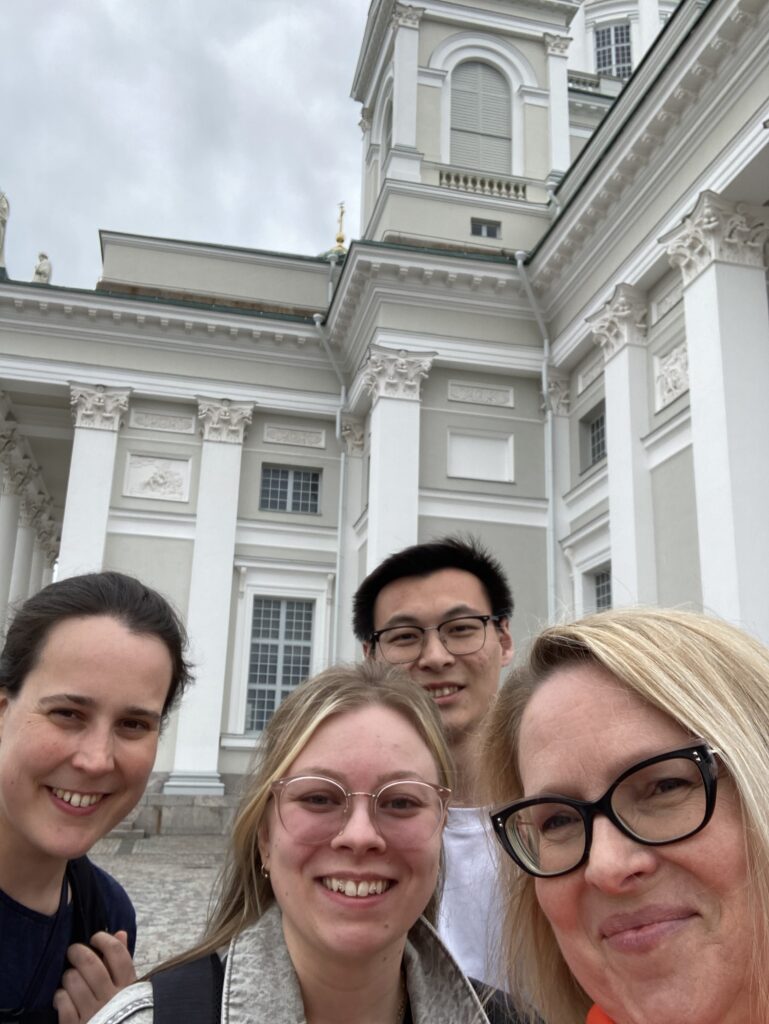
The conference provided valuable opportunities to engage with fellow researchers on the topic of productive AI-mediated interactions in collaboration. The European Association for Research on Learning and Instruction (EARLI) Special Interest Groups 4 & 11 held a joint conference at the University of Helsinki from 10 to 12 June 2026. The RESHAPE project research was presented by Hanni Muukkonen. The paper presentation “Co-creation characteristics in AI hybrid space: entangled interactions” was co-authored with Anni Silvola, Crina Damsa, Anceli Kaveri, and Egle Gedrimiene.

The study employed group problem-solving tasks around challenge scenarios related to typical issues in student life, including time management strategies, insomnia, and loneliness. Students were asked to collaborate with peers and seek advice from a bot, the conversational agent Annie Advisor. The study focused on students’ spontaneous uses of the conversational agent in an AI hybrid space.
Students experimented with the conversational agent in multiple ways, compared strategies, and tested its limits. They solicited responses from the agent, but only rarely introduced critical evaluation of the knowledge presented. The study observed that the way the conversational agent was designed to interact significantly influenced the exchanges. It concluded by highlighting the value of designing tasks that involve reflection on the limitations of conversational agents’ contributions from both epistemic and agentic perspectives.
Advancing Analytical Approaches through a Methods Workshop
The project team also had the opportunity to hold a methods workshop with Prof. Crina Damsa from the University of Oslo. The team reviewed the data and the preliminary analytical framework. The discussion focused on several key analytical questions, including at which levels agency in AI-mediated collaboration can be examined, how epistemic and agentic activities interplay, and what unit of analysis should be addressed.
Further discussions explored the concept of postdigital agency, its possible operationalizations, and how it compares with more socio-cognitive conceptualizations of agency. The team also discussed the various roles assigned to humans and AI in collaboration. These discussions highlighted the need to further define how different students interpret and incorporate AI into group work, as well as what skills and capacities higher education students should be supported to develop. These remain important challenges for the RESHAPE project to address in its future work.