About
Research Objectives

OBJ 1
AI-mediated interaction in group collaboration
OBJ 2
Longitudinal capability development and AI literacy

OBJ 3
Grounded ethics
OBJ 4
Advanced analytical methods for micro-ecological approach
The project aims to advance four areas: a deeper understanding of AI-mediated group collaboration, clearer insights into emerging capability needs, grounded approaches to AI ethics in real educational settings, and research methods that can better explain these complex processes.
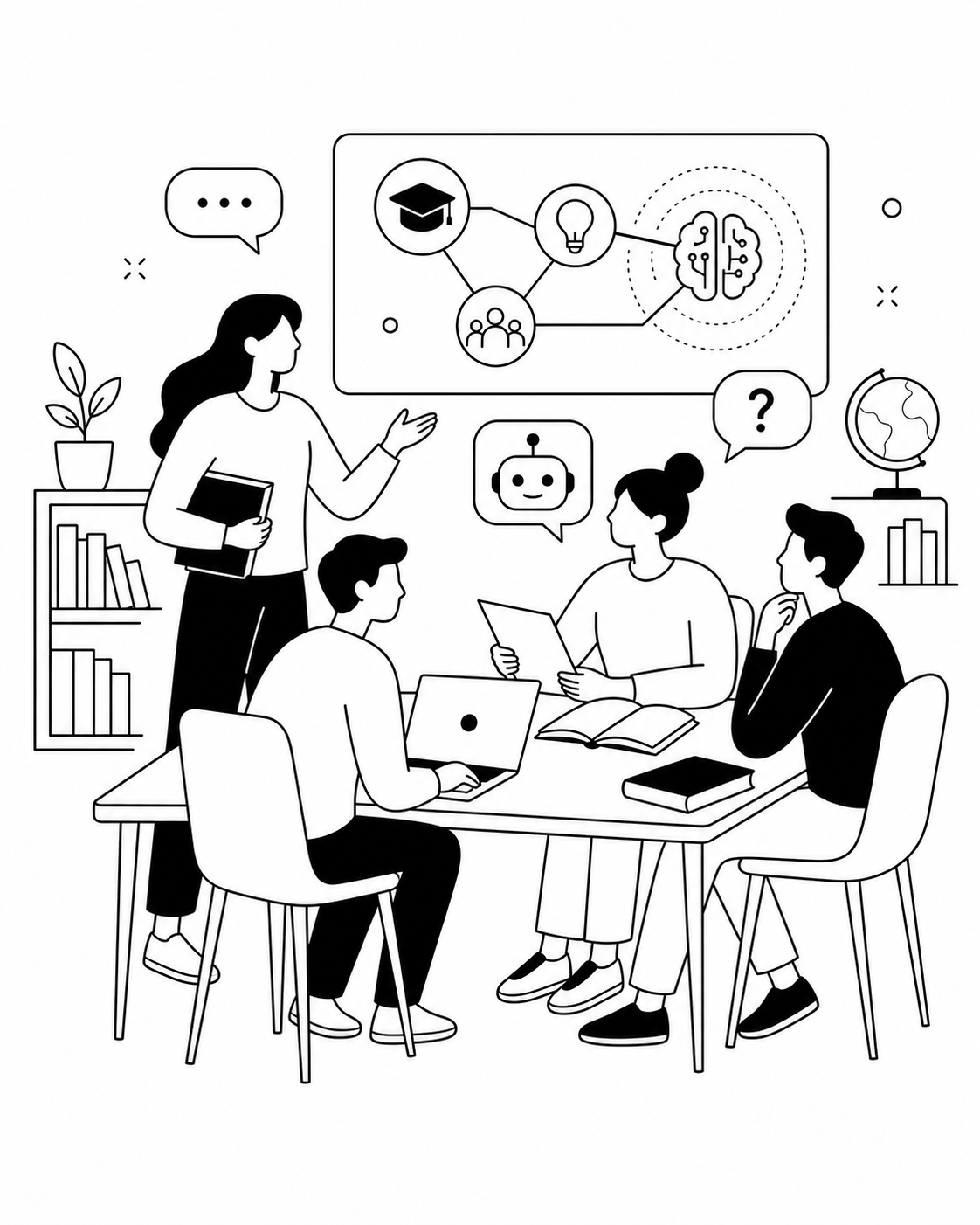
Image note: Some illustrations on this website were created with the assistance of generative AI.Project Background
Generative AI is rapidly entering education, work, and everyday life, transforming learning, working and knowledge creation practices. In higher education in particular, learning is no longer only about collaboration between people; it is increasingly becoming a new form of collaboration in which humans and AI participate together. This shift creates new opportunities, but also new questions: when AI becomes part of group work, how do students judge what is trustworthy? How do they maintain agency and critical reflection? How do they make choices between efficiency, responsibility, and ethics?
RESHAPE responds to this changing landscape. Rather than treating AI as a simple tool, the project seeks to understand how it reshapes collaborative processes, learning experiences, and human action. By studying human–AI interaction in collaborative settings, RESHAPE aims to provide a stronger foundation for educational practice, capability development, and institutional design, while also exploring more sustainable, responsible, and human-centered forms of co-creation with AI.
Project Design
RESHAPE-project builds on the two key project phases that deepen current understanding about the developing agencies, AI capabilities and ethically grounded practices of AI use in education.
1. Observed AI interaction practices
2. Interventions
Methods
RESHAPE uses a micro-ecological approach. This perspective sees human–AI collaboration not as an isolated moment, but as a process that unfolds across multiple levels: individual understanding and judgment, group interaction, course design, teaching arrangements, and broader institutional and social contexts. In practice, the project brings together different kinds of data, including records of group collaboration, logs of human–AI interaction, questionnaires, interviews, and feedback from teachers and other stakeholders. By combining these perspectives, the project aims to build a fuller understanding of how AI-mediated collaboration works, how it changes over time, and what kinds of educational consequences it may have.
Project Timeline
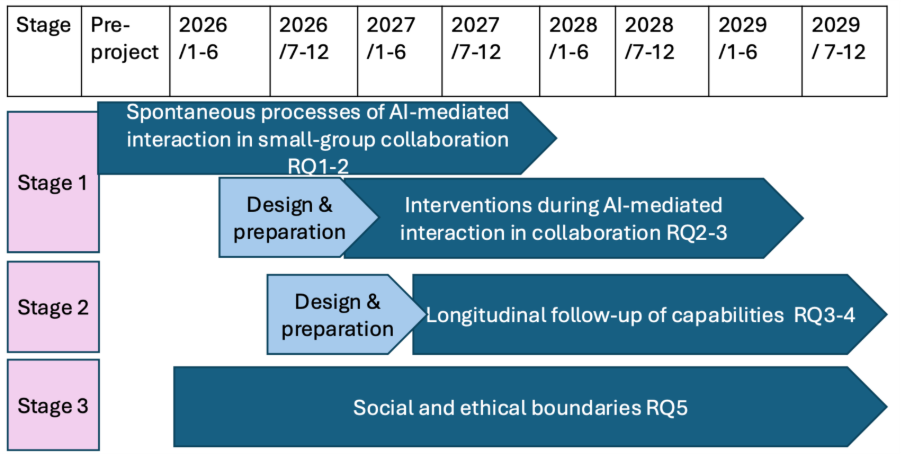
The project is running from 2026 to 2029.
It is broadly structured in three stages:
Stage 1: AI-mediated group collaboration, focusing on how interaction unfolds in real collaborative settings;
Stage 2: capability development and AI literacy, examining how these develop over time;
Stage 3: social and ethical boundaries of AI use, addressing questions of responsibility, norms, and values in education.
Funding Information
RESHAPE is funded by the Research Council of Finland as an Academy Project.